Sectors: custom fragrances
In custom perfume, every blend is its own formula.
A made-to-order perfume house sells a composition and a date. It also promises what is in the bottle. In Specify, a customer composes only what the house makes. They can use their own words if they like. The price and the date follow every choice.
What makes it hard to sell, and how Specify is built for it
A made-to-order perfume is a regulated product, made in batches and never returned. Each problem is set beside how Specify is built for it.
In the trade
Customers describe a mood, not notes
A made-to-order perfume starts from a family or a mood. Something fresh for summer, or warm for evenings. That comes before anyone names a note. Starting from a list of notes means starting with what a customer knows least.
In Specify
Describe it in words
A customer can write what they want. For example, a warm vanilla that is not too sweet. They get notes, a concentration and a size to start from. The reasoning and the price come with them. Every choice can then be changed.
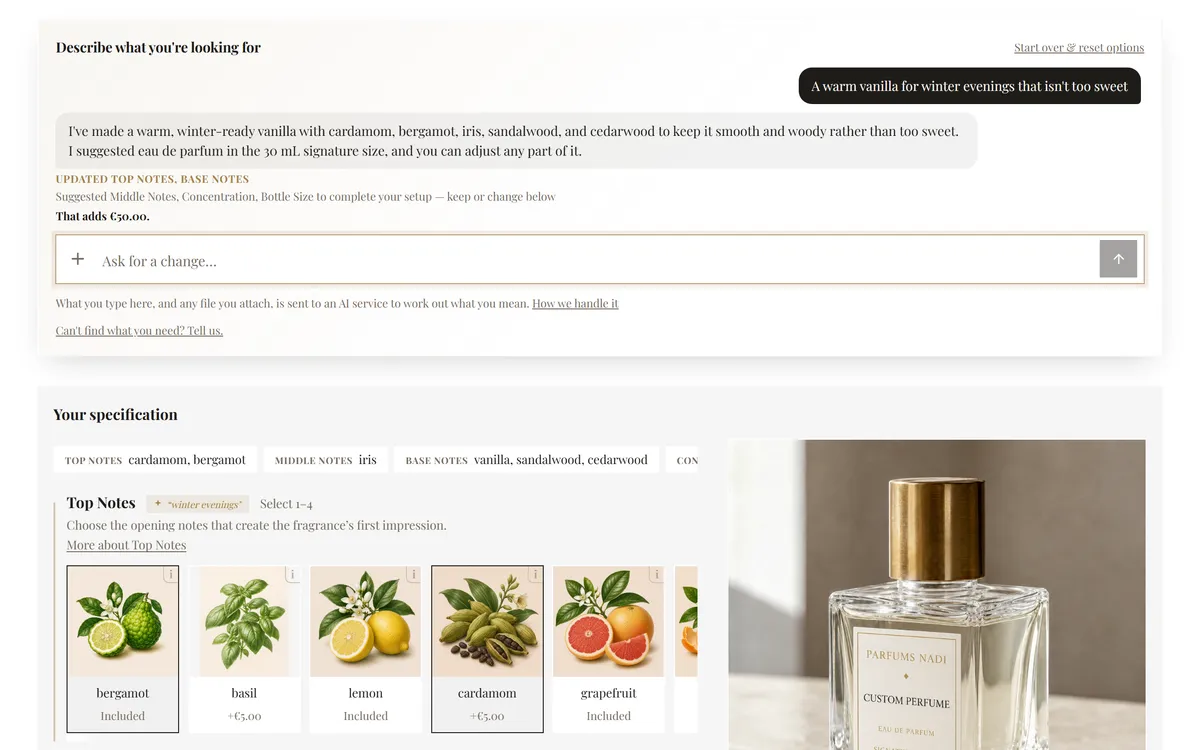
From the fragrance demo: a mood in words becomes notes, a concentration and a size. The store says what that adds to the price. In the trade
Each blend is a regulated product
In the EU a perfume needs a safety report written before it is sold. The industry's limits are percentages of the finished product. So a note can be within its limit as an eau de toilette. As an extrait, the same note can exceed it. A house can only sell what its safety assessments cover.
In Specify
Only what the house can make
The notes, concentrations and sizes a house works with are recorded once. So are the combinations it will not make. For example, a note it will not sell at a given strength. Anything else is refused before anyone pays. The customer gets a plain message, and the house's reason stays internal.
In the trade
A blend's cost depends on its materials
A few notes cost far more than the rest. So one price for every composition is wrong for most of them.
In Specify
The price follows the notes
Each note, concentration and size can carry its own price. The customer sees the total change as they compose. The house is paid for what the blend actually contains.
In the trade
The date is a production slot
A blend is rested after mixing, often for two to six weeks. Then it is bottled. What a customer is promised is a place in that schedule. It moves when a material or a component is late.
In Specify
A date that follows the choices
Every material carries its own lead time. A rule can add time on top, such as the rest a blend needs. The date a customer sees follows from what they composed. It is not a number printed on the site.
In the trade
Nothing personalised comes back
EU consumer law excludes goods made to the customer's specification from the right of withdrawal. A custom perfume cannot be returned, which is why the trade sells samples first.
In Specify
Start from a perfume they know
A customer can begin from one of the house's own perfumes and change any note. They need not compose from a blank list. The house can also offer a small sample size beside the full bottles.
In the trade
Customers ask for what is not offered
A note, a size or a strength outside the house's range arrives as a message. The answer is worked out again each time someone asks.
In Specify
Requests beyond the offer are kept
The request is kept with everything the customer composed. The house answers it once. The answer is kept for the next customer who asks. And the house can see which requests keep coming back.

Run a fragrance house?
Give us your shop's address. We build a preview of your store from your public catalogue. Your own products are in it. Nothing is charged. We also take 3 founding partners in each sector. We build with them on their real demand.
Sources
Public sources for the rules and practice above.