Sectors: bakeries and patisseries
A cake made to order is chosen in parts.
A celebration cake is sized for the party and decorated for the occasion. It is made for one day. A customer picks the size, cake, decoration, the words on top and the day. Specify refuses a day with less notice than the bakery asks for.
What makes it hard to sell, and how Specify is built for it
A fresh cake is made for one occasion and cannot be sold to anyone else. Each problem is set beside how Specify is built for it.
In the trade
A cake is chosen in parts
How many it serves, the sponge and the filling, and the decoration. The words on top, and the day it is wanted. Each choice changes what the bakery makes.
In Specify
Every choice in one order
Sizes, sponges, fillings and decorations are offered as choices. The day is a date, and the words on top are text. A picture to print can be uploaded with them. The order arrives with every choice the customer made.
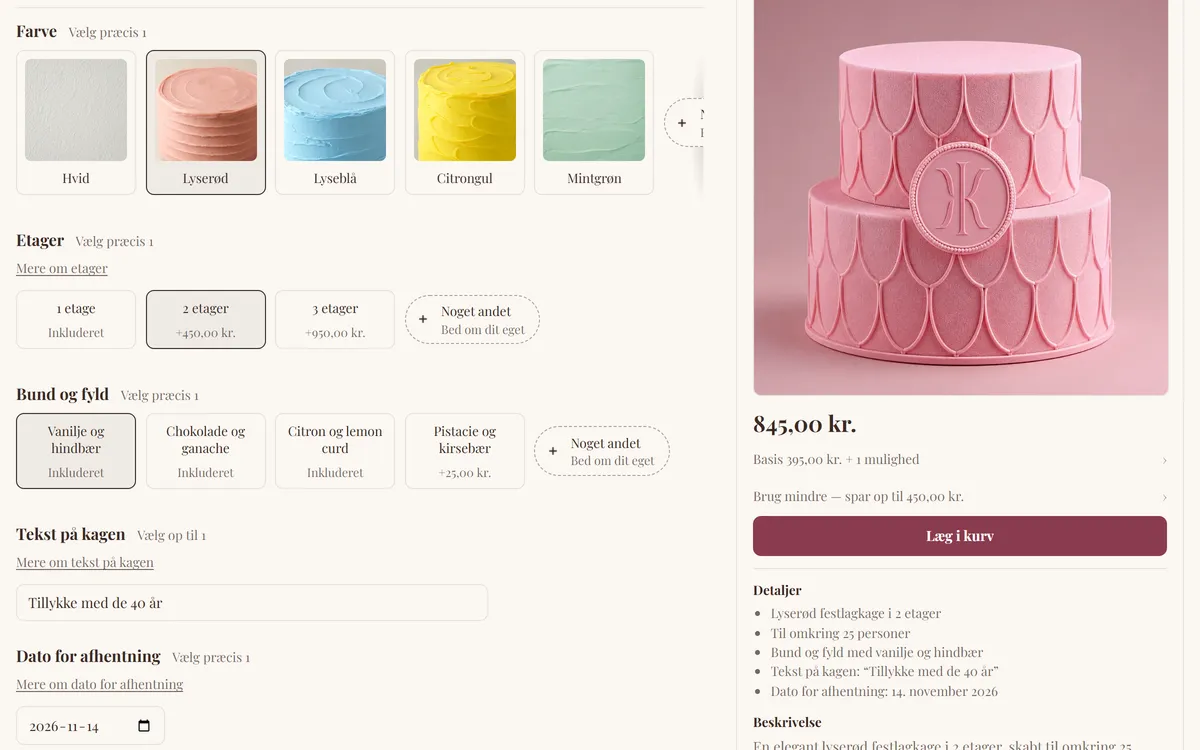
From the bakery demo store: each part is chosen on its own. The colour, the tiers, the sponge and filling, the words on top and the day. The order carries all of them. In the trade
Detail takes time
The more a cake is made for one occasion, the more notice it needs. A wedding cake is ordered weeks or months ahead. Its details take time to get right.
In Specify
Notice that follows the choices
You set how many working days' notice a cake needs. It can apply to every cake, or only to some choices, like a handmade figure. An order for a day with too little notice is refused. The customer is told the earliest day that works.
In the trade
A special cake starts as a conversation
A wedding cake begins with a consultation and often a tasting. The design comes first, and the size follows the guest list.
In Specify
Asked about first, then priced
A cake that needs talking through can be offered for a quote, not a price. The customer sends what they have chosen, and you reply with the price.
In the trade
The words are piped as written
What goes on top is piped exactly as it reaches the bakery. Cake Wrecks is a blog of professionally made cakes gone wrong. It began with an instruction piped as if it were the message.
In Specify
The words in a field of their own
The words to pipe are asked for on their own. Anything else the customer wants to say about the cake is kept apart. They arrive as the customer typed them, not copied out of a message.
In the trade
A cake cannot come back
A fresh cake spoils quickly. One with a name on it is made for one person. Consumer law excludes both from the right to cancel. So a cake that is wrong is remade or lost.
In Specify
Only cakes you make
The combinations you will not make are recorded once. A customer who picks one is told it is not offered. The message is written for them, and they cannot order it.

Bake cakes to order?
Give us your website's address. We build a preview of your store from the cakes on your website. Nothing is charged. We also take 3 founding partners in each sector. We build with them on their real demand.
Sources
Public sources for the rules and practice above.
- Directive 2011/83/EU on consumer rights, Article 16 (EU)
- European Commission, guidance on the Consumer Rights Directive (2021)
- Lag (2005:59) om distansavtal och avtal utanför affärslokaler (Sweden)
- Bryllupsmagasinet, the cake for a wedding (Denmark)
- Bröllopsguiden, before ordering the wedding cake (Sweden)
- Willamette Week, an interview with Jen Yates of Cake Wrecks